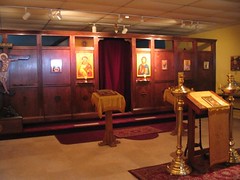
When I walk into an Orthodox Church… one is immediately aware that one has stepped into the presence of what Saint Paul would call the whole family in heaven and earth. You have stepped into the precincts of heaven!
—Thomas Howard
«— Who Has “Found the True Faith”?
—» Former Launch Officer on Trump’s Potential for Nuclear First Strike
November 17, 2015
You Won’t Believe How Ted Cruz Treats Syrian Christians
Link to this post
What people are saying about this article: Comments Off on You Won’t Believe How Ted Cruz Treats Syrian Christians
«— The Real Point of “The Life of Saint Mary of Egypt,” Part III
—» You Won’t Believe How Ted Cruz Treats Syrian Christians
June 4, 2015
Who Has “Found the True Faith”?
Link to this post
“We have seen the true light…![1] We have found the true faith…!” These words appear in a hymn that Byzantine rite Christians sing after communion in the Divine Liturgy. They are a source of pride for many, a source of embarrassment for others. Many Orthodox interpret “the true faith” to mean the entirety of the Eastern Orthodox faith in all of its peculiarity, and converts in particular often take pride having found this “true faith” and abandoned their “former error.”[2] But it may be worthwhile to ask: Is that what the hymn itself says? We do not always sing this hymn after communion: We do not sing it from Pascha to Pentecost.[3] This fact hints that perhaps the hymn’s meaning lies deeper than the surface reading.
Read the rest of “Who Has “Found the True Faith”?”
Linknotes:
- This incipit is Εἴδομεν τὸ φῶς τὸ ἀληθινόν/Eidomen to phos to alethinon. ↩
- This phrase, also translated as “former delusion,” appears in various euchologies in rites for receiving non-Orthodox Christians into the Orthodox Church. ↩
- Archimandrite Robert Taft, sj, cites A. A. Dmitrievski and L. D. Huculak that this hymn is also replaced by the festal apolytikion on dominical feasts. [A History of the Liturgy of Saint John Chrysostom, vol. VI: The Communion, Thanksgiving, and Concluding Rites. Orientalia Christiana Analecta 281. (Rome: Pontificio Instituto Orientale, 2008) 472.] I am not familiar with this variant custom, which is not prescribed in the standard English-language source on East Slavic liturgical practice, The Order of Divine Services by Peter Fekula and Matthew Williams [(Liberty, TN: St John of Kronstadt Press, 2007.)]. ↩

What people are saying about this article: Comments Off on Who Has “Found the True Faith”?
«— The Real Point of “The Life of Saint Mary of Egypt,” Part II
—» Who Has “Found the True Faith”?
March 31, 2015
The Real Point of “The Life of Saint Mary of Egypt,” Part III
Link to this post
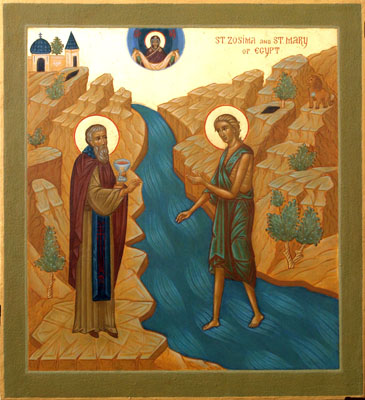 In Part I, I examined the context in which Saint Sophronius wrote “The Life of Saint Mary of Egypt.” He draws on a long tradition of monastic literature in which there are several similar stories which he amplifies in his tale. In Part II, I briefly summarized the tale as Sophronius tells it, and I examined the character of Saint Zosimus. Sophronius describes Zosimus as a nearly perfect monk, the “monk’s monk,” so to speak, who begins to be tormented by thoughts that he is perfect and there is no one on earth who could teach him anything further. He enters the desert as a temporary hermit, according to the custom of his monastery for Lent, “hoping to find a holy father dwelling there, who could help him to find what he longed for,” someone to teach him some new ascetic discipline, so that he can attain even greater heights of ascetic perfection.
When first we encounter Mary, Zosimus wonders if she might be a demonic phantasm, evoking Christ’s temptation in the wilderness,[1] but from the beginning she is shown to be an ascetic who charismatically earns the authority to be a spiritual guide. She is characterized as a thaumaturge—a wonder-worker—who unselfconsciously commands the created order: by clairvoyance and by levitating a cubit (a foot and a half) above the ground. So before she begins narrating her life, the story within the story, we already know she’s a living saint[2] (whereas we may have wondered about Zosimus’ sanctity, since he is described as being precipitously close to succumbing to pride).
Once she begins telling her story, however, she reveals herself to have been a harlot among harlots—the “sinner’s sinner,” as it were. Read the rest of “The Real Point of “The Life of Saint Mary of Egypt,” Part III”
Linknotes:
- Lynda L. Coon, Sacred Fictions: Holy Women and Hagiography in Late Antiquity. (Philadelphia: University of Pennsylvania Press, 1997) 86. ↩
- The ability to work miracles is a common way to indicate sanctity in the lives of the saints. ↩
What people are saying about this article: Comments Off on The Real Point of “The Life of Saint Mary of Egypt,” Part III
«— Teaser for the Next Installment
—» The Real Point of “The Life of Saint Mary of Egypt,” Part III
March 30, 2015
The Real Point of “The Life of Saint Mary of Egypt,” Part II
Link to this post
In the previous installment, we examined the context for the story as told by Saint Sophronius and saw that Saint Mary’s story becomes progressively more magnified. In Sophronius’ version, both the monk who finds Mary and Mary herself become magnified to almost unbelievable proportions.
Sophronius begins by introducing Zosimus, who we are told has been in the monastery since being weaned.[1] After many years of obeying the rule of his monastery, ceaselessly singing psalms and studying the scripture, and acting as spiritual father or guide to many monks far and wide, he begins to be “disturbed, as he said, by certain thoughts, namely, that he had become perfect in all practices and did not need anyone else’s teaching at all.” Zosimus moves to a monastery by the river Jordan which has a custom whereby all the monks leave the monastery during Lent and live as anchorites or hermits in the desert. Zosimus journeys into “the innermost part of the desert,” a key ideal for monasticism, and a key phrase for our story, “hoping to find a holy father dwelling there, who could help him to find what he longed for,” which is a father either to instruct him in some new discipline or to confirm that he has reached perfection.
Read the rest of “The Real Point of “The Life of Saint Mary of Egypt,” Part II”
Linknotes:
- In the summary that follows, quotes are from the translation by Maria Kouli unless other wise noted. Sophronius of Jerusalem, “The Life of Mary of Egypt, the Former Harlot, Who in Blessed Manner Became an Ascetic in the Desert of the <River> Jordan.” Translated by Maria Kouli, in Holy Women of Byzantium: Ten Saints’ Lives in Translation, edited by Alice-Mary Talbot. Byzantine Saints’ Lives in Translation.(&C: Dumbarton Oaks, 1996). I have omitted the brackets with which Kouli notes her interpolations. Greek text of Sophronius is found in Patrologia Graeca (PG) 87:3697–3726. ↩
What people are saying about this article: Comments Off on The Real Point of “The Life of Saint Mary of Egypt,” Part II
«— The Real Point of “The Life of Saint Mary of Egypt,” Part I
—» The Real Point of “The Life of Saint Mary of Egypt,” Part II
March 29, 2015
Teaser for the Next Installment
Link to this post
I said yesterday that I would begin analyzing the role of Saint Zosimus in Saint Sophronius’ “The Life of Saint Mary of Egypt.” I greatly underestimated the toll that assisting my parish in hosting Lenten vespers this evening would take, or how late I would be arriving back at my dormitory. I must beg your forgiveness—I will not be fulfilling that stated goal. Even so, as not to leave you entirely empty of hand, I offer some questions as teasers.
What clue does Saint Sophronius give us early in his story that foreshadows the advent of Saint Mary? He paints a very rosy picture of Zosimus’ life as a monk. Are there any problems? What is Zosimus looking for in the desert?
Tune in tomorrow.
What people are saying about this article: Comments Off on Teaser for the Next Installment
«— The Cross is a Time Machine (and It’s Bigger on the Inside)
—» Teaser for the Next Installment
March 28, 2015
The Real Point of “The Life of Saint Mary of Egypt,” Part I
Link to this post
“The Life of Saint Mary of Egypt” by Saint Sophronius of Jerusalem comes to us in a form that is, to put it bluntly, very inefficient. When I was first investigating the Orthodox Church, I tried to download a copy of “The Life of Saint Mary of Egypt.” This was the late 1990s, and finding information on the internet was often feast or famine. What I got was not right at all. It started out talking about some guy named (Saint) Zosimus, and it kept going on and on about him. Obviously not the life of Mary. So I deleted it and tried again. Finally, I realized that Saint Mary’s story does not start until somewhere between one third and one half of the way into what is ostensibly her Life!
Who cares about Zosimus? Sure, he’s the monk who finds St Mary out in the desert,[1] but does that mean a third to one-half of the Life of Mary needs to be taken up with his story? I thought for a very long time that “The Life of Saint Mary of Egypt” needed an editor. More Mary—no Zosimus. On closer inspection, though, the whole point of this story lies in the contrast between Zosimus and Mary, and it’s a surprise ending.
Read the rest of “The Real Point of “The Life of Saint Mary of Egypt,” Part I”
Linknotes:
- That is, according to the version of the story told by Saint Sophronius of Jerusalem. ↩
What people are saying about this article: Comments Off on The Real Point of “The Life of Saint Mary of Egypt,” Part I
«— Hatteras-style Clam Chowder
—» PO;DR—Pop-over; Didn’t Read.
September 27, 2013
Beautiful Websites Will Save the World
Link to this post
A dear classmate of mine wrote me today to ask for examples of good parish website design—the “best to examine for style, layout, information and the most welcoming to the non-Orthodox.” My reply was short on examples, but long on some fundamental design principles. I wondered if maybe I had not really answered the question my friend asked. In concluding, I realized why I think these principles are so important: I have seen too many bad parish websites. Getting a parish website right is not optional. It is a pastoral and evangelical necessity. Here is my reply to my friend (edited for style and content):
Read the rest of “Beautiful Websites Will Save the World”
What people are saying about this article: Comments Off on Beautiful Websites Will Save the World
«— The Roots of This Tree Go Deep
—» Is “Carol of the Bells” Really Copyrighted?
November 14, 2012
Four Reasons It’s Not “Advent”
Link to this post
Tomorrow begins the Christmas fast in Byzantine-rite churches following new calendars.[1] Notice that I did not call it “Advent.” Orthodox Christians sometimes lapse into calling this fast “Advent” because it overlaps with the Latin-rite season of preparation for Christmas which goes by that name. But ask yourself: Are they really the same? So, with a nod to the four Sundays of Advent, here are four reasons why they are not. Read the rest of “Four Reasons It’s Not “Advent””
Linknotes:
- For the Orthodox, the new calendar is the revised Julian calendar, which is almost identical to its counterpart in Byzantine-rite Catholic Churches, the Gregorian calendar. ↩
«— Warning: These 3 things could ruin your Valentine’s Day
—» Four Reasons It’s Not “Advent”
October 19, 2012
The Roots of This Tree Go Deep
Link to this post
I often try to forget or ignore stuff I have done that is embarrassing or hard to explain. (Maybe you do, too.) I look for ways to spin things so they sound awesome (or at least acceptable). But sometimes, turning points force me to recall my roots and not to ignore them. This week I plunged into just such a reverie, because a parish which I helped establish purchased some land recently and this week planted a cross there. Unfortunately, I missed this beautiful service, but when I saw the photos online, the sight of that weathered old cross on the site of the church’s new property made me very, very happy. Let me tell you why. The roots of that cross go very deep for me and for that parish.
Saint Athanasius Orthodox Church, just outside of Lexington, Kentucky, was founded about fifteen years ago.[1] In those early days, we dreamed a lot. Boy, did we dream! But one dream stood out: Read the rest of “The Roots of This Tree Go Deep”
Linknotes:
- When we first started, we were outside the normal boundaries of the Orthodox church. We call this kind of existence outside the ordinary boundaries of the church “non-canonical.” In the case of our mission, we were continuing in the tradition we received from the church that founded us — a very Orthodox thing to do, ironically. When that church requested to join an established Orthodox church, so did we. ↩
What people are saying about this article: Comments Off on The Roots of This Tree Go Deep
«— The Monagamous Front?
—» Warning: These 3 things could ruin your Valentine’s Day
June 1, 2011
The Crucial Cure
Link to this post
A close friend of mine (and my godson) recently preached on the Sunday of the Paralytic. As I commented when he posted the text of his sermon, “I particularly liked the reversal of the ‘crutch’ accusation at the end, and how it tied in with the central medical theme. Great job, and I hope that your hearers were edified.” I highly recommend reading the whole thing.
I would like to offer one further remark — and it may simply reflect a different perspective: I have become somewhat sensitive of late to the fact that the cross is the center and sine qua non of Christian faith. Chris mentioned the Lord’s passion (which is the cross); it could have been a bit more central to the entire homily. The cross is the sacrament from which every other sacrament flows. You see this in icons of the crucifixion: A cup capturing the blood and water flowing from the Lord’s side. (This image of baptism and eucharist — of the church as sacrament — represents a timeless connection rather than an historical event. The crucified Lord eternally gives birth to the church in the timeless reality of the cross.) I would have nailed the fact that the Lord’s cross is the medicine (and sometimes, we don’t get a spoonful of sugar to make it go down more easily).
Sometimes we speak easily of the church and theology without referring it back to the cross. However, the earliest patristic writers, as well as many of the most important through the centuries, always took the cross as their starting point and referred to it constantly. The more that our teaching becomes able to stand apart from the cross (which is the revelation of God enfleshed), the less it resembles patristic teaching. A theology which can stand without the cross is not the gospel and it is not really Christian.
In closing, I reemphasize that I really liked this homily. However, I think that the cross is crucial to Christian teaching and thought it important enough to mention. In some ways, this merely reflects a different perspective. I am emphasizing this crucial element of Christian teaching partly due to the deep vale where my own journey has taken me. However, part of it is also a shift in thinking spearheaded by Fr John Behr, now the dean at St Vladimir’s Seminary, where I am a student. I highly recommend his book, The Mystery of Christ. To get an idea of his central thesis, read this article: “The Paschal Foundations of Christian Theology.”
What people are saying about this article: Comments Off on The Crucial Cure
«— Holy Patrick of Ireland
—» The Monagamous Front?
March 27, 2011
Veneration of the Happy Joy
Link to this post
Today’s gospel:
Mark 8:34-9:1 (Schmemann Standard Version)
And calling the crowd to him with his disciples, he said to them, “If anyone would come after me, let him find what makes him happy and take up his joy and follow me. For whoever would save his happiness is blessed, but whoever loses his joy for my sake and the gospel’s will be cast out into eternal darkness where the fire never ceases and the worm never dies. For what does it profit a man to gain his soul and forfeit his happiness? For what can a man give in return for his joy? For whoever is ashamed of me and of my happiness in this adulterous and sinful generation, of him will the Son of Man also be ashamed when he comes in the happiness of his Father with the holy angels.” And he said to them, “Truly, I say to you, there are some standing here who will not taste death until they see the kingdom of God coming with joy.”
Today’s hymn:
Troparion of the resurrection
O Lord, save your people, and make joyful your inheritance. Grant happiness to the people who are always happy, and by your resurrection preserve your habitation.
«— Love in the Silence
—» Holy Patrick of Ireland
March 10, 2011
Prayer of Saint Ephrem
Link to this post
O Lord and master of my life! Dispel from me the spirit of discouragement and slothfulness, of ambition and vain talk!
Prostration.
Instead, give me the spirit of prudence and humility, of patience and charity.
Prostration.
Yes, my king and Lord, let me look at my own sins and refrain from judging others: For you are bless’d unto ages of ages, amen.
Prostration.
Then, with three lesser reverences:
O God, have mercy on me, a sinner!
O God, in your mercy wipe out my sins!
I have sinned very often, Lord; forgive me!
Prayer text copyright © The Monks of New Skete.
What people are saying about this article: Comments Off on Prayer of Saint Ephrem
«— Holiday Songs after Epiphany
—» Love in the Silence
February 2, 2011
The Transformation
Link to this post
Nine years ago, a tiny transformation occurred. Christ the Life-giver Orthodox Church in Nicholasville, Ky., formerly a mission of the Evangelical Orthodox Church (EOC), entered the Orthodox Church in America (OCA). Unlike other parishes that entered at the same time, every single member of Christ the Life-giver chose to remain with the parish in its transition to the OCA, an amazing detail that is sometimes forgotten. In the days that followed, a new name (Saint Athanasius) appeared in the window, and the layman who was formerly the priest would again be ordained to lead the tiny band of pilgrims. To better understand the place of that decisive moment in the history of the parish, I present it here through the lens of my own life.
My story begins in 1995, when I entered the Roman Catholic Church. Before that, I was an evangelical, and I continued to attend an evangelical college. One of my art professors began reading about Eastern Orthodoxy and attending prayers held in the living room of a nearby seminarian, David Rucker. Rucker was studying missiology. He served in Hong Kong, and he was frustrated over inadequate responses to ancestor veneration in Asian cultures. He believed that Eastern Orthodoxy could provide a positive answer for Asians. My professor’s interest piqued my own, and I began attending the Sunday evening prayers. In the fall of 1995, Rucker began holding catechism classes. He invited me to attend, and I did.
In 1996, Rucker’s doctoral thesis advisor unexpectedly died, and he faced the prospect of completely rewriting his thesis on ancestor veneration in Chinese culture. When he discussed returning to Hong Kong with his missions board, he realized that Orthodox practices had become more than an academic investigation. The evangelical mission board forbade him to use the sign of the cross or icons in his ministry. They required the impossible. Read the rest of “The Transformation”
«— A Beautiful Vigil
—» The Graveyard
November 21, 2010
The Coming One
Link to this post
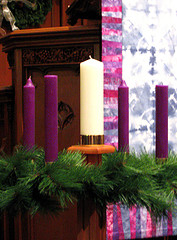 A meditation on the meaning of the season of Advent.
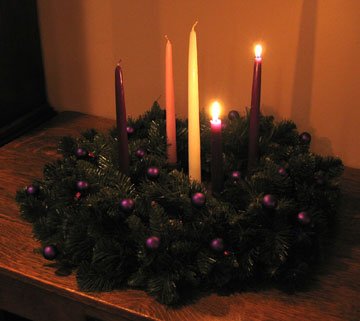
I grew up in the West, and so Advent was an important part of the preparation for Christmas.[1] The Advent wreath, Advent calendars, singing “O Come, O Come, Emmanuel,” “Come, Thou Long Expected Jesus” — these memories burn in mind like a flame as shining examples of what Advent means.
Advent comes from the Latin adventus, meaning “coming.” “Beginning the Church’s liturgical year, Advent is the season leading up to the celebration of Christmas. The Advent season is a time of preparation that directs our hearts and minds to Christ’s second coming at the end of time and also to the anniversary of the Lord’s birth on Christmas
,” according to the website of the US Conference of Catholic Bishops. The second coming of Christ is the focus of Advent because the readings and proper hymnography of the church remind the faithful of the yearning of suffering Israel, as well as the imminent coming of the Lord. The burning desire of the old covenant saints burns in our hearts as we long for the coming of the Lord.
The first Sunday of Advent always follows the last Sunday of the church year, the Solemnity of Christ the King. Prior to the liturgical reforms of the twentieth century, the gospel for Christ the King led directly into the yearning of Advent (Mt 24.15–35): “And then the sign of the Son of man will appear in heaven; then, too, all the peoples of the earth will beat their breasts; and they will see the Son of man coming on the clouds of heaven with power and great glory.
” (v. 30, NJB)[2] The King is coming: Be ready! It is the perfect prelude to the penitence of the coming season of preparation. Read the rest of “The Coming One”
What people are saying about this article: Comments Off on The Coming One
«— Jokers
—» The Coming One
November 15, 2010
A Beautiful Vigil
Link to this post
At St Vladimir’s Seminary, where we have been hosting the relics of our community’s patron, the holy great prince Vladimir, the Seminary’s octet and St Tikhon’s Seminary’s Mission Choir sang the Saturday all-night vigil antiphonally. There are already some videos up. The videos uploaded on November 13 all capture the vigil we celebrated before the relics of St. Vladimir.
What people are saying about this article: Comments Off on A Beautiful Vigil
Copyright © 2002–2011 Kevin Robert (Basil) Fritts, all rights reserved.